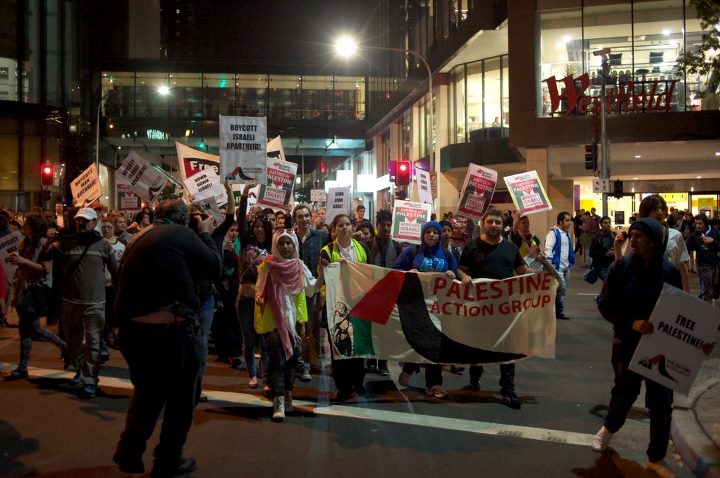
150 supporters of Palestine staged a rally in Parramatta in support of the global campaign of boycotts, divestment and sanctions against Israeli apartheid today. The protest was timed to also commemorate the massacres at the Sabra and Shatilla Palestinian refugee camps in Lebanon 30 years ago.
The Police had yesterday requested the Palestine Action Group cancel the event, but organisers decided to proceed as planned.
Demonstrators were addressed by South African activist Kolin Thumbadoo, who was president of the Anti-Apartheid Movement in Australia during the campaign against apartheid in South Africa.
In his speech Kolin stated, “As I was then, I am now, an implacable, unapologetic anti-racist. As I was opposed to a white minority regime in South Africa, so to am I opposed to a racist Zionist regime in occupied Palestine.”
The protest marched to the Max Brenner chocolate shop in Parramatta to highlight it’s connections with the Strauss Group, an Israeli corporation which publicly supports two of the most notorious brigades in the Israeli Defence Forces, the Golani and Gavati brigades.
“Just as in the struggle against Apartheid in South Africa, companies that support or profit from Israeli Apartheid should be boycotted,” said one of the protest organisers, Patrick Langosch.
The Palestine Action Group plans to hold more demonstrations in the future to continue to support the BDS campaign and the struggle of the Palestinians.
Protecting our Noosa environmental assets from development is essential – both for their intrinsic ecological values and to ensure a prosperous future for Noosa’s major industry – green tourism.As I contemplate the ongoing zionist invasion of Palestine against the popular will of Indigenous Palestinian people, this happy local event reminds me that privileged white people are winning in a predominantly white democracy where Indigenous people are marginalised.
On another level however, this first step toward Noosa’s de-amalgamation from the Sunshine Coast Regional Council represents what a community can do from the grassroots to redress undemocratic wrongs – the forced amalgamation by the Blight government and theft of our successful shire’s money to prop up two unfinancial southern shires ravaged by Councils complicit with developers’ unsustainable greed.
NOOSA’S bid to separate from the Sunshine Coast Regional Council is one step closer to success.
Local Government Minister David Crisafulli announced this morning he would progress Noosa’s application for de-amalgamation to the Boundaries Commissioner for further consideration.
Noosa is only one of five successful applicants.
Nineteen former shires applied for de-amalgamation.
Boundaries Commissioner Col Meng and the Queensland Treasury Corporation will work together over the next two and half months to consider the cases for de-amalgamation.
“This was always going to be a difficult process but if a proposal stacks up, the community will make the final decision at a referendum,” he said.
Free Noosa chairman Noel Playford says he’s delighted that Noosa has made the cut, although not surprised.
“Let’s be honest, if our submission had not made it to the next stage, then nothing would.”
Mr Playford took Noosa’s 70-page submission and a petition of residents to the Minister’s office late last month.
He says the Boundaries Commissioner and his staff will soon be heading for Noosa to speak with local people and gauge for himself just how deep is the passion for de-amalgamation.
The former Noosa mayor said it was a once-only shot at breaking away from the “giant Sunshine Coast Regional Council”.
“For those who want to protect our balance of low-key development, lifestyle and natural beauty, we will probably never get another chance.”
Mr Playford has urged local people to make a brief statement to the Boundaries Commissioner on the issue.
“We need people to tell him what they think, why they want their council back. He’s read about the passion for independence in Noosa, but now he needs to see if for himself.”
The Noosa area – a UNESCO Biosphere Reserve – represents an environment on which we humans and the animal and plant species with whom we share a habitat rely. Having respect for the land on which we all depend means having respect for Indigenous values. Noosa will be protected through de-amalgamation – and our environmental and democratic values will prevail.
“A Noosa businessman suggested to me the other day the SCRC is like a giant slug sucking the life out of Noosa. That may be a little over the top but you get the picture.”
Elise Hendrick [@translator_eli] takes a satirical look at the duplicitous efforts of mainstream privileged white media to promote bigotry and Ayaan Hirsi Ali’s islamophobic, faux-feminist views.
In Australia, neoliberalism is understood largely as an economic model, characterised by the sweeping privatisations that Carr championed in NSW. But, actually, it’s more than that. Neoliberalism differs from a classical free market orientation precisely because it extends beyond the economy to embrace the entire social world, which it then recasts on market lines. The neoliberal project doesn’t just assign to the market those roles previously understood as quintessentially responsibilities of government (such as, say, the provision of utilities); rather, it recasts governance itself as an entrepreneurial project, with productivity and profit increasingly normalised as the criteria to judge success and failure.
In other words, neoliberalism effects a thoroughgoing depoliticisation. Most obviously, this manifests itself in a belief, now shared by almost all mainstream politicians, that government should not intervene in the market. This conviction – a consensus about the role of politicians as simply economic caretakers – already renders out of bounds most of the policies that previous generations of social democrats would have taken for granted.
More importantly, neoliberalism also recasts governance and the democratic process in market terms. The resulting political culture casts citizens as autonomous economic agents, relating to each other and to the state as individual entrepreneurs. The politician no longer appeals to party members, unionists, religious believers or specific communities; instead, he or she addresses individual consumers, touting for their business in much the same way as any other corporation.
In the neoliberal polity, it makes no more sense for citizens to rally than in does for, say, users of Apple computers to hold a march. In both cases, their role is simply to consume, with the ballot box understood as an extension of the cash register. If the latest iPhone is a dud, buy an Android; if the Labor Party’s been in power too long, vote Liberal.
Because democracy is understood as a market, rallies, protests, demonstrations and strikes seem, to the neoliberal, not as expressions of the popular will but as outrageous assaults on the democratic system.
To be clear, we’re not seeing the end of the right to protest, so much as its hollowing out. In the neoliberal era, tightly-controlled top-down events are still considered legitimate – witness the staged spectacles at the recent Republican and Democratic conventions in the US.
Sabra – a sleeping girl
The men left
War slept for two short nights,
Beirut obeyed and became the capital…
A long night
Observing the dreams in Sabra,
Sabra is sleeping.
Sabra – the remains of a dead body
She bid farewell to her horsemen and time
And surrendered to sleep out of tiredness.. and the Arabs who threw her behind them.
Sabra – and what the soldiers Departing from Galilee forgot
She doesn’t buy and sell anything but her silence
To buy flowers to put on her braided hair.
Sabra – sings her lost half, between the sea and the last war:
Why do you go?
And leave your wives in the middle of a hard night?
Why do you go?
And hang your night
Over the camp and the national anthem?
Sabra – covering her naked breasts with a farewell song
Counts her palms and gets it wrong
While she can’t find the arm:
How many times will you travel?
And for how long?
And for what dream?
If you return one day
for which exile shall you return,
which exile brought you back?
Sabra – tearing open her chest:
How many times
does the flower bloom?
How many times
will the revolution travel?
Sabra – afraid of the night. Puts it on her knees
covers it with her eyes’ mascara. Cries to distract it:
They left without saying
anything about their return
Withered and tended
from the rose’s flame!
Returned without returning
to the beginning of their journey
Age is like children
running away from a kiss.
No, I do not have an exile
To say: I have a home
God, oh time ..!
Sabra – sleeps. And the fascist’s knife wakes up
Sabra calls who she calls
All of this night is for me, and night is salt
the fascist cuts her breasts – the night reduced –
he then dances around his knife and licks it. Singing an ode to a victory of the cedars,
And erases
Quietly .. Her flesh from her bones
and spreads her organs over the table
and the fascist continues dancing and laughs for the tilted eyes
and goes crazy for joy, Sabra is no longer a body:
He rides her as his instincts suggest, and his will manifests.
And steals a ring from her flesh and blood and goes back to his mirror
And be – Sea
And be – Land
And be – Clouds
And be – Blood
And be – Night
And be – Killing
And be – Saturday
and she be – Sabra.
Sabra – the intersection of two streets on a body
Sabra, the descent of a Spirit down a Stone
And Sabra – is no one
Sabra – is the identity of our time, forever.
‘Let me tell you about what life is like for the Palestinians I know still living in Sabra and Shatila. More than 9,000 refugees live within one square kilometer. Most of the dwellings are overcrowded, damp, and poorly ventilated; some have tin roofs. Open sewage systems run through the camps. The population is vulnerable to hostilities between various political factions. Refugees are denied the right to work in most jobs. Impoverished, they depend on an already overworked and underfunded UNRWA for basic health services and education. Inadequate nutrition, chronic illnesses and poor health are common. Children are deprived of a good education. Many refugees have never been out of their camp! Third and fourth generations are being born, growing up, and dying in these camps. It is bleak and appalling. The future holds little hope for any improvement in their lives.’
Following the sessions in Barcelona (which focused on EU complicity), London (on Corporate Complicity) and Cape Town (on the crime of Apartheid), the New York Tribunal will go back to the root of the conflict and focus on UN and US responsibility in the denial of the Palestinian right to self-determination.
Alice Walker, Archbishop Desmond Tutu and others tell you why you should support this historical initiative to bring Israel to account for its brutal crimes against the Palestinian people under the aegis of international law.
‘The Tribunal finds that Israel subjects the Palestinian people to an institutionalised regime of domination amounting to apartheid as defined under international law. This discriminatory regime manifests in varying intensity and forms against different categories of Palestinians depending on their location. The Palestinians living under colonial military rule in the Occupied Palestinian Territory are subject to a particularly aggravated form of apartheid. Palestinian citizens of Israel, while entitled to vote, are not part of the Jewish nation as defined by Israeli law and are therefore excluded from the benefits of Jewish nationality and subject to systematic discrimination across the broad spectrum of recognised human rights. Irrespective of such differences, the Tribunal concludes that Israel’s rule over the Palestinian people, wherever they reside, collectively amounts to a single integrated regime of apartheid.’
 From the Palestine Action Group Sydney: