Fringe Poll

Who will win the next Australian Federal election?

View Results

Loading ... Loading ...

What I'm Tweeting ...

Archives

Is the West capable of reflection on its white supremacist crimes? 1700% Project: Mistaken for Muslim

  • Share/Bookmark

The first successful dock protest against Israeli apartheid ever at Oakland

The boycotts, divestments and sanctions movement in the US just took a gigantic leap forward with a successful solidarity action between activists and longshoremen at Oakland, CA to prevent an Israeli ship from unloading its cargo.

In Oakland, California an Israeli ship was blocked by protesters for the first time in history. 700-1000 protesters blocked three different gates at 5:30 A.M. keeping dockworkers from unloading the Israeli cargo.

ILWU members refused to cross picketline – citing “health & safety” provisions of their contract. Management demanded “instant arbitration.” The arbitrator took a look at the picketlines at each gate to the SSA Terminal and ruled that ILWU members were justified in refusing to cross.

All dockworkers were sent home with FULL PAY.

This vid features the Brass Liberation Orchestra.

Sphere: Related Content

  • Share/Bookmark

Free Ezra Nawi, Israeli Human Rights Activist

Sign the petition to free courageous protestor Ezra Nawi, who tried to stop a military bulldozer from destroying the homes of Palestinian Bedouins in the South Hebron region. Israel’s occupation is illegal under international law.

Sphere: Related Content

  • Share/Bookmark

Fadi Andrawos – Falasteen W Lebnan : aid contingents reach Gaza

As George Galloway’s 300 strong Viva Palestina aid contingent waits at the Rafah crossing to enter Gaza, celebrated author Alice Walker is already there.

The visitors include Pulitzer Prize-winning author Alice Walker and about 60 other people who arrived over the weekend to celebrate International Women’s Day and see for themselves what life is like for Palestinians after Israel’s devastating 22-day offensive.

The group visited women’s centres and organizations across the Gaza Strip yesterday, handing out about 2,000 aid baskets. They listened to the stories of the women, some of whose children were killed in the war. Over the next few days they will visit refugee camps and neighbourhoods levelled by Israeli shells and artillery.

“This is not a gimmick; it’s a strategy,” Kim Elliott, Toronto publisher of the independent news website http://www.rabble.ca, said in a phone interview from her hotel in Gaza City. “It’s for [us] to see what it’s really like and make the personal connection and go back to [our] homes to talk about it.”

“All great changes come from minorities,” Alice Walker insisted during a phone interview from the home of a Palestinian family where she was being hosted.

“In fact, they usually come from two to three people – especially if they are writers,” said Ms. Walker, best known for her novel The Color Purple. She said she danced, sang and ate and listened to the women and that she saw “a lot of sadness on the faces of the children.”

The visitors not only had to take a bus for hours from Cairo across the Sinai Desert, they were required to pay their embassies to write letters declaring that they assumed sole responsibility for their lives upon entering the Gaza Strip.

“It cost $130!” said Ehab Lotayef, a 50-year-old Montreal engineer who was able to enter Gaza with the assistance of the U.S. women’s peace group Code Pink, which organized the delegation.

“I think they didn’t want a bunch of women with big banners camping out at the border crossing,” said Sandra Ruch, 52, a Torontonian and program co-ordinator for Women’s Coalition for Peace in Israel and Independent Jewish Voices in Canada.

For 2009 International Women’s Day, we at the Fringe celebrate the dedication and intelligence of women throughout the world who resist apathy and make a difference.

Sphere: Related Content

  • Share/Bookmark

Closed Zone – Boycotts & More Protests Against Israeli Land Theft

While Arab bloggers protest Israel’s despicable forced evictions and confiscations of Palestinian homes and land, in the West Bank, activist women prepare to march for International Women’s Day.

Tomorrow the nonviolent Palestinian resistance will take to their fields and towns, to their confiscated land to confront confiscation for the Wall and settlements.

Expectations are for a violent Israeli response that is an omnipresent aspect of the popular resistance. Western Ramallah’s Bil’in and Na’lin will demonstrate, as will Qalqilia’s Jayyous.

Tomorrow is a special day as every Friday the West Bank chooses a pertinent theme with which to devote demonstrations, in addition to protesting the general policy of the occupying Israeli authorities: last week it was the forcible destruction and eviction of East Jerusalem’s Silwan and Al Bustan to the south of Al Aqsa Mosque.

Tomorrow the honor will be paid to international women’s day. Southern Bethlehem’s Umm Salamuna is expected to come out in droves along with activists from throughout the province that received last week confiscation orders for dozens more dunams of its lands.

Women activists in Bethlehem issued an invitation to “all those of you who care about women’s issues.” Hundreds are expected on Friday.

Over at Jews sans Frontieres, Anthony Cordesman’s flawed CSIS report on Israel’s attack on Gaza is soundly examined and glaring omissions highlighted – Cordesman “diplomatically fails to mention the U.S. attempt to overthrow the elected Palestinian government that led to Hamas taking over”, “He also ignores that whole history of potential negotiations with Hamas”.

Cordesman’s work hards to absolve Israel from war crimes because he is concerned about the effects vigorous prosecution of such crimes would have on the deployment of U.S. forces.

Cordesman’s concern is to defend the right of the U.S. and it’s allies, whoever they may be, to fight “assymetric wars” that inherently depend on harm to civilians. International law in its present form is not congruent with the way U.S. strategic interests are evolving. (and U.S. hostility to the ICJ and other treaties that put limits on warfare is well known.) CSIS, and the corporate elite it serves, got its money’s worth.

On the boycott and apartheid front, the cessation of negotiations by the British Embassy with Leviev owned Africa-Israel, a company building on stolen Palestinian land in the West Bank is a landmark decision, setting a terrific precedent for more UK divestments, boycotts and sanctions against Israel in the future.

Tony Greenstein is encouraged by the progress of the international boycott on apartheid Israel.

it is clear that the growing level of support for Boycott in the trade unions and similar organisations, coupled with a consumer boycott and individual businesses also refusing to trade with Israel is making its mark.

To keep an eye on – the “long-delayed trial of two former AIPAC staffers accused of passing classified info to the media and the Israeli government.” Gershom Gorenborg quotes Doug Bloomfield in the New Jersey Jewish News:

One of the topics AIPAC won’t want discussed, say these sources, is how closely it coordinated with Benjamin Netanyahu in the 1990s, when he led the Israeli Likud opposition and later when he was prime minister, to impede the Oslo peace process being pressed by President Bill Clinton and Israeli Prime Ministers Yitzhak Rabin and Shimon Peres.

That could not only validate AIPAC’s critics, who accuse it of being a branch of the Likud, but also lead to an investigation of violations of the Foreign Agents Registration Act.

“What they don’t want out is that even though they publicly sounded like they were supporting the Oslo process, they were working all the time to undermine it,” said a well-informed source.

Sphere: Related Content

  • Share/Bookmark

Gandhi Rejected Zionism

A private chuckle emanates from the land of bananas – juxtaposing Chomsky, didact he is, with the visionary Gandhi and his words of 80 years ago is a minor recompense for the grinding realisation that Chomsky may well be right – US foreign policy is cynically fixed in the fifties still, remnants of the cold war stultifying change, recognition of universal human rights, law and pursuit of happiness other than for the privileged, paranoid, bigoted west. Why should they change? the Americans are asleep again, they didn’t know what hit them when 911 came, and have missed the message. Injustice breeds resistance and the more monstrous the injustice, as with the ignored Palestinian cause, the more likely history will repeat, unless the nascent global voice which is taking wing in boycotts, protests, twitters, facebooks and other extraordinary means circumvents the sluggardly grinding wheels of an unwilling political machine.

Here’s Noam anyway, since I’m collecting him of late – it’s a great piece, if depressing.

Barack Obama is recognized to be a person of acute intelligence, a legal scholar, careful with his choice of words. He deserves to be taken seriously – both what he says, and what he omits. Particularly significant is his first substantive statement on foreign affairs, on January 22, at the State Department, when introducing George Mitchell to serve as his special envoy for Middle East peace.

Mitchell is to focus his attention on the Israel-Palestine problem, in the wake of the recent US-Israeli invasion of Gaza. During the murderous assault, Obama remained silent apart from a few platitudes, because, he said, there is only one president – a fact that did not silence him on many other issues. His campaign did, however, repeat his statement that “if missiles were falling where my two daughters sleep, I would do everything in order to stop that.” He was referring to Israeli children, not the hundreds of Palestinian children being butchered by US arms, about whom he could not speak, because there was only one president.

On January 22, however, the one president was Barack Obama, so he could speak freely about these matters – avoiding, however, the attack on Gaza, which had, conveniently, been called off just before the inauguration.

Obama’s talk emphasized his commitment to a peaceful settlement. He left its contours vague, apart from one specific proposal: “the Arab peace initiative,” Obama said, “contains constructive elements that could help advance these efforts. Now is the time for Arab states to act on the initiative’s promise by supporting the Palestinian government under President Abbas and Prime Minister Fayyad, taking steps towards normalizing relations with Israel, and by standing up to extremism that threatens us all.”

Obama is not directly falsifying the Arab League proposal, but the carefully framed deceit is instructive.

The Arab League peace proposal does indeed call for normalization of relations with Israel – in the context – repeat, in the context of a two-state settlement in terms of the longstanding international consensus, which the US and Israel have blocked for over 30 years, in international isolation, and still do. The core of the Arab League proposal, as Obama and his Mideast advisers know very well, is its call for a peaceful political settlement in these terms, which are well-known, and recognized to be the only basis for the peaceful settlement to which Obama professes to be committed. The omission of that crucial fact can hardly be accidental, and signals clearly that Obama envisions no departure from US rejectionism. His call for the Arab states to act on a corollary to their proposal, while the US ignores even the existence of its central content, which is the precondition for the corollary, surpasses cynicism.

The most significant acts to undermine a peaceful settlement are the daily US-backed actions in the occupied territories, all recognized to be criminal: taking over valuable land and resources and constructing what the leading architect of the plan, Ariel Sharon, called “Bantustans” for Palestinians – an unfair comparison because the Bantustans were far more viable than the fragments left to Palestinians under Sharon’s conception, now being realized. But the US and Israel even continue to oppose a political settlement in words, most recently in December 2008, when the US and Israel (and a few Pacific islands) voted against a UN resolution supporting “the right of the Palestinian people to self-determination” (passed 173 to 5, US-Israel opposed, with evasive pretexts).

Obama had not one word to say about the settlement and infrastructure developments in the West Bank, and the complex measures to control Palestinian existence, designed to undermine the prospects for a peaceful two-state settlement. His silence is a grim refutation of his oratorical flourishes about how “I will sustain an active commitment to seek two states living side by side in peace and security.”

Also unmentioned is Israel’s use of US arms in Gaza, in violation not only of international but also US law. Or Washington’s shipment of new arms to Israel right at the peak of the US-Israeli attack, surely not unknown to Obama’s Middle East advisers.

Obama was firm, however, that smuggling of arms to Gaza must be stopped. He endorses the agreement of Condoleeza Rice and Israeli foreign minister Tzipi Livni that the Egyptian-Gaza border must be closed – a remarkable exercise of imperial arrogance, as the Financial Times observed: “as they stood in Washington congratulating each other, both officials seemed oblivious to the fact that they were making a deal about an illegal trade on someone else’s border – Egypt in this case. The next day, an Egyptian official described the memorandum as `fictional’.” Egypt’s objections were ignored.

Returning to Obama’s reference to the “constructive” Arab League proposal, as the wording indicates, Obama persists in restricting support to the defeated party in the January 2006 election, the only free election in the Arab world, to which the US and Israel reacted, instantly and overtly, by severely punishing Palestinians for opposing the will of the masters. A minor technicality is that Abbas’s term ran out on January 9, and that Fayyad was appointed without confirmation by the Palestinian parliament (many of them kidnapped and in Israeli prisons). Ha’aretz describes Fayyad as “a strange bird in Palestinian politics. On the one hand, he is the Palestinian politician most esteemed by Israel and the West. However, on the other hand, he has no electoral power whatsoever in Gaza or the West Bank.” The report also notes Fayyad’s “close relationship with the Israeli establishment,” notably his friendship with Sharon’s extremist adviser Dov Weiglass. Though lacking popular support, he is regarded as competent and honest, not the norm in the US-backed political sectors.

Obama’s insistence that only Abbas and Fayyad exist conforms to the consistent Western contempt for democracy unless it is under control.

Obama provided the usual reasons for ignoring the elected government led by Hamas. “To be a genuine party to peace,” Obama declared, “the quartet [US, EU, Russia, UN] has made it clear that Hamas must meet clear conditions: recognize Israel’s right to exist; renounce violence; and abide by past agreements.” Unmentioned, also as usual, is the inconvenient fact that the US and Israel firmly reject all three conditions. In international isolation, they bar a two-state settlement including a Palestinian state; they of course do not renounce violence; and they reject the quartet’s central proposal, the “road map.” Israel formally accepted it, but with 14 reservations that effectively eliminate its contents (tacitly backed by the US). It is the great merit of Jimmy Carter’s Palestine: Peace not Apartheid, to have brought these facts to public attention for the first time – and in the mainstream, the only time.

It follows, by elementary reasoning, that neither the US nor Israel is a “genuine party to peace.” But that cannot be. It is not even a phrase in the English language.

It is perhaps unfair to criticize Obama for this further exercise of cynicism, because it is close to universal, unlike his scrupulous evisceration of the core component of the Arab League proposal, which is his own novel contribution.

Also near universal are the standard references to Hamas: a terrorist organization, dedicated to the destruction of Israel (or maybe all Jews). Omitted are the inconvenient facts that the US-Israel are not only dedicated to the destruction of any viable Palestinian state, but are steadily implementing those policies. Or that unlike the two rejectionist states, Hamas has called for a two-state settlement in terms of the international consensus: publicly, repeatedly, explicitly.

Obama began his remarks by saying: “Let me be clear: America is committed to Israel’s security. And we will always support Israel’s right to defend itself against legitimate threats.”

There was nothing about the right of Palestinians to defend themselves against far more extreme threats, such as those occurring daily, with US support, in the occupied territories. But that again is the norm.

Also normal is the enunciation of the principle that Israel has the right to defend itself. That is correct, but vacuous: so does everyone. But in the context the cliche is worse than vacuous: it is more cynical deceit.

The issue is not whether Israel has the right to defend itself, like everyone else, but whether it has the right to do so by force. No one, including Obama, believes that states enjoy a general right to defend themselves by force: it is first necessary to demonstrate that there are no peaceful alternatives that can be tried. In this case, there surely are.

A narrow alternative would be for Israel to abide by a cease-fire, for example, the cease-fire proposed by Hamas political leader Khaled Mishal a few days before Israel launched its attack on December 27. Mishal called for restoring the 2005 agreement. That agreement called for an end to violence and uninterrupted opening of the borders, along with an Israeli guarantee that goods and people could move freely between the two parts of occupied Palestine, the West Bank and the Gaza Strip. The agreement was rejected by the US and Israel a few months later, after the free election of January 2006 turned out “the wrong way.” There are many other highly relevant cases.

The broader and more significant alternative would be for the US and Israel to abandon their extreme rejectionism, and join the rest of the world – including the Arab states and Hamas – in supporting a two-state settlement in accord with the international consensus. It should be noted that in the past 30 years there has been one departure from US-Israeli rejectionism: the negotiations at Taba in January 2001, which appeared to be close to a peaceful resolution when Israel prematurely called them off. It would not, then, be outlandish for Obama to agree to join the world, even within the framework of US policy, if he were interested in doing so.

In short, Obama’s forceful reiteration of Israel’s right to defend itself is another exercise of cynical deceit – though, it must be admitted, not unique to him, but virtually universal.

The deceit is particularly striking in this case because the occasion was the appointment of Mitchell as special envoy. Mitchell’s primary achievement was his leading role in the peaceful settlement in northern Ireland. It called for an end to IRA terror and British violence. Implicit is the recognition that while Britain had the right to defend itself from terror, it had no right to do so by force, because there was a peaceful alternative: recognition of the legitimate grievances of the Irish Catholic community that were the roots of IRA terror. When Britain adopted that sensible course, the terror ended. The implications for Mitchell’s mission with regard to Israel-Palestine are so obvious that they need not be spelled out. And omission of them is, again, a striking indication of the commitment of the Obama administration to traditional US rejectionism and opposition to peace, except on its extremist terms.

Obama also praised Jordan for its “constructive role in training Palestinian security forces and nurturing its relations with Israel” – which contrasts strikingly with US-Israeli refusal to deal with the freely elected government of Palestine, while savagely punishing Palestinians for electing it with pretexts which, as noted, do not withstand a moment’s scrutiny. It is true that Jordan joined the US in arming and training Palestinian security forces, so that they could violently suppress any manifestation of support for the miserable victims of US-Israeli assault in Gaza, also arresting supporters of Hamas and the prominent journalist Khaled Amayreh, while organizing their own demonstrations in support of Abbas and Fatah, in which most participants “were civil servants and school children who were instructed by the PA to attend the rally,” according to the Jerusalem Post. Our kind of democracy.

Obama made one further substantive comment: “As part of a lasting cease-fire, Gaza’s border crossings should be open to allow the flow of aid and commerce, with an appropriate monitoring regime…” He did not, of course, mention that the US-Israel had rejected much the same agreement after the January 2006 election, and that Israel had never observed similar subsequent agreements on borders.

Also missing is any reaction to Israel’s announcement that it rejected the cease-fire agreement, so that the prospects for it to be “lasting” are not auspicious. As reported at once in the press, “Israeli Cabinet Minister Binyamin Ben-Eliezer, who takes part in security deliberations, told Army Radio on Thursday that Israel wouldn’t let border crossings with Gaza reopen without a deal to free [Gilad] Schalit” (AP, Jan 22); srael to keep Gaza crossings closed…An official said the government planned to use the issue to bargain for the release of Gilad Shalit, the Israeli soldier held by the Islamist group since 2006 (Financial Times, Jan. 23); “Earlier this week, Israeli Foreign Minister Tzipi Livni said that progress on Corporal Shalit’s release would be a precondition to opening up the border crossings that have been mostly closed since Hamas wrested control of Gaza from the West Bank-based Palestinian Authority in 2007″ (Christian Science Monitor, Jan. 23); “an Israeli official said there would be tough conditions for any lifting of the blockade, which he linked with the release of Gilad Shalit” (FT, Jan. 23); among many others.

Shalit’s capture is a prominent issue in the West, another indication of Hamas’s criminality. Whatever one thinks about it, it is uncontroversial that capture of a soldier of an attacking army is far less of a crime than kidnapping of civilians, exactly what Israeli forces did the day before the capture of Shalit, invading Gaza city and kidnapping two brothers, then spiriting them across the border where they disappeared into Israel’s prison complex. Unlike the much lesser case of Shalit, that crime was virtually unreported and has been forgotten, along with Israel’s regular practice for decades of kidnapping civilians in Lebanon and on the high seas and dispatching them to Israeli prisons, often held for many years as hostages. But the capture of Shalit bars a cease-fire.

Obama’s State Department talk about the Middle East continued with “the deteriorating situation in Afghanistan and Pakistan… the central front in our enduring struggle against terrorism and extremism.” A few hours later, US planes attacked a remote village in Afghanistan, intending to kill a Taliban commander. “Village elders, though, told provincial officials there were no Taliban in the area, which they described as a hamlet populated mainly by shepherds. Women and children were among the 22 dead, they said, according to Hamididan Abdul Rahmzai, the head of the provincial council” (LA Times, Jan. 24).

Afghan president Karzai’s first message to Obama after he was elected in November was a plea to end the bombing of Afghan civilians, reiterated a few hours before Obama was sworn in. This was considered as significant as Karzai’s call for a timetable for departure of US and other foreign forces. The rich and powerful have their “responsibilities.” Among them, the New York Times reported, is to “provide security” in southern Afghanistan, where “the insurgency is homegrown and self-sustaining.” All familiar. From Pravda in the 1980s, for example.

Hillary Clinton once again espouses that which Chomsky alludes to – that Hamas must meet the unmeetable three conditions, before being included in negotiations. One wonders if she is aware of the impossibility of her demands and is being deliberately obtuse.

In the below video, Norman Finkelstein discusses Gandhi philosophy in relation to the Israeli occupation and oppression of Palestinians.

More recently, Finkelstein discusses Gandhi’s principles of non-violence in relation to the Obama administration.

Sphere: Related Content

  • Share/Bookmark

The Plank in Western Eyes Courtesy of The Elephant in the Room

Lloyds Bank is the target of protests since it has ceased the ability of Interpal to send aid to Gaza. In Bristol, protesters have forced the bank to close its doors. Suspect Paki has the story, and so does Syd Walker, who chronicles protests aimed at the BBC in England and Israelis in New Zealand.

Syd also comments on Obama’s rumoured appointment of Israel Firster Dennis Ross to ambassadorship in the Middle East.

To begin to restore America’s credibility, Obama and Secretary of State Clinton must appoint a genuine honest broker for negotiations over the Middle East. Someone of independence and integrity. If they prefer to appoint a foreign national, how about Bishop Tutu or Mikhail Gorbachev?

Substituting a Zionist A-Team for the Zionist B-Team is not acceptable, except to Israel. What is acceptable only to Israel is no longer acceptable to the world.

With new evidence of Israel’s criminal use of white phosphorus in civilian areas, the Zionist state is contemplating a unilateral cease fire forestalling any negotiations with the democratically elected Hamas government. Before it does so, according to Reuters Israel is bombing Gaza with renewed ferocity.

Ending a night of sporadic gunfire, the roar of jet aircraft around10 p.m. ET was followed by heavy explosions flashing over points to the south and north of the city of Gaza.

The Israeli army said 50 targets here hit, including 16 tunnels, two mosques from which troops were fired on, three bunkers, eight rocket-launching pads and six mined areas including a booby-trapped building.

A spokeswoman had no immediate comment on a report that two civilians were killed near a school. About 45,000 Gazans are sheltering in U.N.-run schools in the enclave.

Tipsy Livni is in the US organising support for Israeli plans.

Foreign Minister Tzipi Livni, hoping to succeed Olmert when Israel votes on February 11, said on Friday that an end to the war “doesn’t have to be in agreement with Hamas but rather in arrangements against Hamas.”

She was in Washington sealing a pact for U.S. help to ensure Hamas no longer smuggles arms to Gaza via Egypt. She said Hamas still holds kidnapped soldier Gilad Shalit, a cause celebre in Israel, whom Hamas considers a trump card.

Exiled Hamas leader Khaled Meshaal on Friday called Israel’s ceasefire terms unacceptable. Demanding an end to the punitive Israeli blockade of Gaza, he said Hamas would fight on.

Hamas negotiators, however, were due to meet the Egyptians on Saturday to discuss Israel’s response to their conditions.

Hamas offers a one-year, renewable truce on condition that all Israeli forces withdraw within a week and that all the border crossings with Israel and Egypt are opened.

The Times reports that shells have been found in Gaza with markings identifying them sd white phosphorous shells – shells made in the US.

Remnants of an Israeli white phosphorus shell, identified by the marking on the outer casing — M825A1 — have been found in the village of Sheikh Ajilin in western Gaza.

Witnesses in Gaza said that the shell was fired on January 9 and was taken indoors as evidence. They recalled seeing thick smoke and smelling a strong odour in keeping with the garlic-like smell associated with white phosphorus.

Hebrew writing on the shell casing reads “exploding smoke” — the term the Israeli army uses for white phosphorus. Doctors who examined the shell said that it appeared to include phosphorus residue.

Residents said that they suffered burns on their feet when they walked where the shelling had taken place.

A suspected phosphorus victim was taken from Gaza across the border into Egypt yesterday. Abdul Rahman Shaer, 16, was transferred to an Egyptian hospital from Rafah. He was suffering from severe chemical burns to his face and body. Paramedics from Gaza said that doctors at the hospital were sure the chemical agent was phosphorus.

And in the Guardian:

Fresh evidence of the firing of white phosphorus weapons by Israeli forces in Gaza has emerged from witnesses heard by the Guardian and first hand accounts by human rights groups of their use against civilians.

Graphic descriptions of attacks by Israeli forces near the Gaza town of Khan Younis are contained in footage shot by Fida Qishta for the International Solidarity Movement and obtained by the Guardian.

A woman described how on Tuesday Israeli forces “started to fire phosphorus bombs against the people, of course, they are civilians …”

The UN is calling for investigation into this morning’s shelling of a UN school/shelter which killed at least two boys and injured 14 people.

Christopher Gunness, a UNRWA spokesman, said several rounds hit the UN school at about 6:45am. After a short pause, the third floor of the school took a direct hit, killing the two and injuring another 14 people.

Witnesses said four more people were killed when other shells struck nearby as people tried to escape.

About 1,600 civilians had sought refuge from the fighting inside the building, Gunness said.

“The Israeli army knew exactly our GPS co-ordinates and they would have known that hundreds of people had taken shelter there,” he said.

“When you have a direct hit into the third floor of a UN school, there has to be an investigation to see if a war crime has been committed.”

Israel vs Palestine

The latest Jewish Voice for Peace newsletter is inspiring.

One bright spot in the midst of this terrible darkness is the explosion of dissent in all corners of the globe.

The profoundly ignorant statement made by Clare Gatehouse in the UN’s Emergency sitting GA/10809 on Jan 16 saddens me – that our government is still blinded by a cloud of hasbara is a fair indication of the control Israel is exerting on Australian foreign policy.

CLARE GATEHOUSE ( Australia) said Australia was deeply disturbed by the violence in the Gaza Strip and southern Israel and strongly supported the call in Council resolution 1860 (2009) for an immediate, durable and fully respected ceasefire. She supported the resolution’s recognition of the need to address arms smuggling and open border crossings and its call for the unimpeded provision and distribution of humanitarian assistance throughout the Gaza Strip.

She welcomed the Egyptian French ceasefire proposal and the important role played by Egypt and others, including Secretary General Ban Ki-Moon. A solution had to be found to end Hamas’ rocket attacks against Israel, which had led to the current crisis, and it must also end arms smuggling into Gaza. The crisis had demonstrated the vital need for a two State solution to the Israel Palestine conflict.

Australia was deeply concerned that the conflict had profoundly affected civilians. She condemned any action by Hamas to deliberately endanger civilian lives and called on Israel to do all it could to ensure the safety of United Nations and humanitarian workers. She said Australia had committed $5 million in additional assistance to the people of Gaza on 1 January 2009 to provide emergency food and medical supplies and cash assistance to conflict affected families.

The Australian government has failed to notice that there were no Hamas rockets fired during the truce prior to Israel’s breach of the truce on November 4, 2008. Perhaps Stephen Smith should phone dual Australian Israeli citizen and Olmert spokesperson Mark Regev who confirmed this on Channel 4. Furthermore $5million is a palty amount to offer to Gaza, which has suffered $1.4b in damages at this point.

The President of the General Assembly excoriated Israel for its brutality.

Miguel d’Escoto Brockmann, president of the 63rd session of the United Nations General Assembly (GA), went on with opening the special session despite Israel’s effort to block it, saying that “it’s ironic that Israel is trying to silence the General Assembly.”

“The relentless assault continues,” the GA president said. “Gaza is ablaze.”

“During this assault, more than 1,000 Palestinians have been killed, one-third of them children. More bodies remain buried under the rubble, out of reach of humanitarian workers because the shelling is too intense — the living would be killed trying to reach the dead,” he said. “If this onslaught in Gaza is indeed a war, it is a war against a helpless, defenseless, imprisoned population.”

“It seems to me ironic that Israel, a state that more than any other owes its very existence to a (1948) General Assembly resolution, should be so disdainful of United Nations resolutions,” the GA president said.

More than 1,150 Palestinians have been killed and 5,100 wounded, many of them civilians since Israel commenced its unprovoked attack on Gaza.

The latest reports from the UN are alarming to say the least.

Mr. Ging said UNRWA, which aids 750,000 Palestinian refugees in Gaza, about half the population, is establishing alternative warehouses and is “up and running again” after Israeli shells destroyed the warehouse in its main compound yesterday, sending hundreds of tons of food and medicine up in flames. The fire continued to burn today. “Massive devastation and destruction” was reported in the area of the compound, he added.

The Agency is getting to most of those in need but there are still areas in the north of the Gaza Strip that are cut off. “It is an issue of major concern to us,” he said.

Describing the situation on the ground, Mr. Ging stressed that it was “really terrible” that patients in hospitals come under fire, adding that innumerable numbers of people are living in shock. UNRWA is preparing to help traumatized children when they return to school.

“People are in mortal danger here in the Gaza Strip, and have been for the last 21 days and nights and the casualty figures bear that out. At the moment there is a glimmer of hope. They are bewildered, shell-shocked and in real fear but they are grasping at this latest round of diplomatic efforts in the hope that this might end,” he said.

“I myself would never have predicted what has happened in full view of the whole world over these past 21 days and nights, but it has happened and continues right now, but I am hopeful, not least because of the efforts of our Secretary-General, which is there for all to see, and I wish others would join him in the degree of commitment and pro-activity that he is bringing to bear.”

Asked what was the most outrageous scene he had witnessed, Mr. Ging replied: “Of course, it’s always the dead children and it’s very traumatic to see that, and it’s equally traumatic to see children who are still alive but whose lives have been ruined, multiple amputees. The most traumatic sight of this conflict is visible in the morgues and in the hospitals.

“And each and every one of those cases is of course for the individuals and their families massively traumatic and life-altering, in most of them because of the horrific nature of the injuries, they’re not just a flesh wound.”

UN Humanitarian Coordinator for the occupied Palestinian territory Max Gaylard said the situation for hospitals, medical workers and the injured was alarming and deteriorating, stressing that hospitals must be protected and remain neutral areas under any circumstances. In a statement, he noted that 13 health workers had been killed and 22 injured, and 16 health facilities and 16 ambulances damaged or destroyed since the start of the Israeli military operation.

Meanwhile, the Office of the UN Special Coordinator for the Middle East Peace Process (UNSCO) reported that 69 truckloads of goods were allowed entry into Gaza from Israel today, including 26 trucks for UNRWA with flour, blankets, rice and bread, and one truck of medical supplies for the UN World Health Organization (WHO). At the Rafah crossing with Egypt, nearly 15 truckloads of food and medical and relief supplies passed through and 18 medical cases were evacuated.

The UN World Food Programme (WFP) reported that, in addition to its regular caseload of some 250,000 Gazans, it delivered canned meat and high energy biscuits to 13 Gaza hospitals, enough for 6,000 patients and staff for up to one month. WFP is also distributing ready-to-eat food to overcome the scarcity of cooking gas.

And here’s the latest report from the UN Office for Coordination of Humanitarian Affairs:

FIELD UPDATE ON GAZA FROM THE HUMANITARIAN COORDINATOR

16 January 2009, 1700 hours

“The Red Cross is not managing to coordinate evacuation of wounded people. There are people right next to the Red Crescent hospital bleeding to death. We cannot get to them as the Israelis shoot at us.” (Palestinian medic)

“Today the UN compound in Gaza has been shelled again. I conveyed my strong protest and outrage to the Defense Minister and to the Foreign Minister… The time has come for the violence to stop and for us to change fundamentally the dynamics in Gaza.” (United Nations Secretary General Ban Ki Moon)

January the fifteenth witnessed the most intense fighting to date, with Israeli ground forces advancing deeper into densely populated areas, particularly Gaza City with an estimated population of 500,000 people. Since the morning of 15 January, relentless shelling of the Gaza Strip has struck a number of buildings, among them the main UNRWA compound in Gaza City and three hospitals.

Large numbers of civilians are trapped in their homes while thousands more are seeking refuge with host families and in UNRWA emergency shelters. There are no safe places or bomb shelters within the Gaza Strip and the borders remain closed. Security for medical personnel and access to medical facilities remains extremely difficult.

Following a year and a half of blockade and almost three weeks of intense bombardment by land, sea and air, the Gaza Strip is witnessing a devastating humanitarian crisis. The casualty rate is rapidly rising; extensive damage has been incurred to public infrastructure and homes; and water, sanitation and electricity services are barely functioning. Supplies of essential commodities such as food, cooking gas, water and fuel are diminishing and increasingly hard to obtain. Children, who make up 56 percent of the Gaza population, continue to bear the brunt of the violence and account for a significant proportion of the dead and severely maimed.

PROTECTION OF CIVILIANS

The Israeli army remains present in the north, east and Rafah border areas. Aerial bombardment, artillery shelling and naval firing continued throughout 14 January, in particular in the Zaitoun, Tuffah, eastern Gaza and other suburbs of Gaza City. The Al-Arqam private school in Gaza City was shelled, as was the Sheikh Radwan cemetery, destroying many of the graves.

The fighting intensified in the morning of 15 January, with Israeli forces advancing deeper into Gaza City from all sides. Residential buildings, high rise buildings, three hospitals and the UNRWA compound were among the buildings hit.

As of 14 January, UNRWA was hosting 39,669 displaced Palestinians in 41 emergency shelters in Gaza, most of them in the Gaza Governorate (17 shelters with 13,884 IDPs) and in North Gaza (13 shelters with 16,282 IDPs).

MEDICAL FACILITIES

The Al Wafa Hospital east of Gaza City (the only rehabilitation hospital in the Gaza Strip), Al Fata Hospital west of Gaza City, and Al Quds Hospital were directly hit by the Israeli army. One Al Fata Hospital ambulance and two Al Quds Hospital ambulances were hit.

Around 0530 hours, at least 500 people living in Tel el Hawa sought refuge at the Al Quds Palestinian Red Crescent Society Hospital. From 1030 hours, shelling struck the administrative building and damaged the second floor of the hospital. A fire broke out, putting at risk the patients, staff and displaced persons in the hospital. The fire was eventually extinguished at around 1400 hours. As people were leaving the hospital, one fatality and four injuries were reported due to fighting in the area. At about 1800 hours, the 500 displaced people were evacuated to an UNRWA emergency shelter.

UNRWA Main Compound

At approximately 1000 hours, Israeli shells struck the main UNRWA compound, injuring three persons. The shells caused a fire that destroyed a workshop and the main warehouse which housed hundreds of tonnes of humanitarian supplies, including those due to be distributed today, 15 January. Approximately 700 Palestinians were taking refuge in the compound at the time of the incident; they were eventually evacuated to a nearby emergency shelter.

Media Building

At approximately 0900 hours on 15 January, following intensification of shelling in the neighbourhood, journalists in Gaza City took refuge in the Al Shurouq Tower which houses the main offices and studios of various local and international media outlets. Despite assurances by the Israeli army that the building was not a target, the 13th storey of the building was struck by a shell at approximately 1115 hours. Two journalists from Abu Dhabi TV were injured. The explosion caused a fire which damaged transmission facilities.

Casualties

Palestinian Ministry of Health (MoH) figures as of 1600 hours 15 January are 1,086 Palestinians dead, of whom 346 are children and 79 are women. The number of injured stands at 4,900, of whom 1,709 are children and 724 are women. The danger to medical staff and the difficulty of extracting the injured from collapsed buildings makes proper evacuation and estimation of casualties difficult, including the determination of the number of Palestinian male civilian casualties.

From 1600 hours on 14 January until 1600 hours on 15 January, a total of 73 Palestinians were killed, of whom 24 were children, and 340 were injured, of whom 109 were children.

Nine Israeli soldiers have been killed since 27 December. Palestinian militants continue to fire rockets and mortars from the Gaza Strip into Israel. According to the Magen David Adom, the national society of the International Red Cross/Red Crescent Movement, Israeli civilian casualties stand at four dead and 78 injured since 27 December.

OCHA’s casualty figures do not include the number of Palestinians or Israelis treated for shock.

Priority Needs

Ceasefire: While any mechanism that facilitates humanitarian assistance is welcome, only an immediate ceasefire will be able to address the severe humanitarian and protection crisis that the population of Gaza is faced with.

Protection of Civilians: Civilians, notably children who form 56 percent of Gaza’s population, are bearing the brunt of the violence. As one of the most densely populated places in the world, more civilians risk being killed or injured if the conflict continues. The parties to conflict must respect the norms of International Humanitarian Law (IHL), in particular the principles of distinction and proportionality.

Access for ambulance and rescue teams: An unknown number of dead, injured and trapped people remain in houses which have been shelled and in areas where hostilities are ongoing. Due to attacks on ambulances, medical staff are fearful of reaching these places. The evacuation of wounded and safe passage of ambulances and health workers are fundamental tenants of IHL, and should be facilitated at all times. This includes the safe passage for evacuation of injured through Rafah crossing.

Speaking of unilateral action, Syria is calling for a full Arab boycott of Israel.

Bashar al-Assad, the president of Syria, told like-minded leaders meeting in the Gulf state of Qatar that the 2002 Arab peace initiative, backed by the entire 22-member Arab League, was no longer valid. Syria had already announced an end to its own talks with Israel, brokered by Turkey and focusing on the Golan Heights.

The Arab initiative promises recognition of Israel in return for a withdrawal to the 1967 borders and a just settlement of the Palestinian problem. It is widely considered to be the only basis on which a comprehensive Middle East peace settlement could be reached and has already attracted the attention of US president-elect Barack Obama.

Assad’s unilateral announcement does not mean the plan has been formally withdrawn – that would require a full Arab summit. But his statement illustrates just how difficult it will be to rescue hopes for progress towards a wider regional peace once the immediate Gaza crisis is over.

The Syrian demand to cut links with Israel was directed primarily at Egypt and Jordan, both of which have had peace treaties and full diplomatic ties with Israel since 1979 and 1994 respectively.

Protest in the UK amongst academics is continuing to mount with terse letters in major newspapers.

The massacres in Gaza are the latest phase of a war that Israel has been waging against the people of Palestine for more than 60 years. The goal of this war has never changed: to use overwhelming military power to eradicate the Palestinians as a political force, one capable of resisting Israel’s ongoing appropriation of their land and resources. Israel’s war against the Palestinians has turned Gaza and the West Bank into a pair of gigantic political prisons. There is nothing symmetrical about this war in terms of principles, tactics or consequences. Israel is responsible for launching and intensifying it, and for ending the most recent lull in hostilities.

Israel must lose. It is not enough to call for another ceasefire, or more humanitarian assistance. It is not enough to urge the renewal of dialogue and to acknowledge the concerns and suffering of both sides. If we believe in the principle of democratic self-determination, if we affirm the right to resist military aggression and colonial occupation, then we are obliged to take sides… against Israel, and with the people of Gaza and the West Bank.

We must do what we can to stop Israel from winning its war. Israel must accept that its security depends on justice and peaceful coexistence with its neighbours, and not upon the criminal use of force.

We believe Israel should immediately and unconditionally end its assault on Gaza, end the occupation of the West Bank, and abandon all claims to possess or control territory beyond its 1967 borders. We call on the British government and the British people to take all feasible steps to oblige Israel to comply with these demands, starting with a programme of boycott, divestment and sanctions.

Will the TV celebrity of Palestinian doctor Abu al-Aish who lost three daughters to an Israeli tank shell bursting into their home impact upon the self-righteous, hypnotised Israeli public? or is he just another inferior Gazan slave like the rest for them?

“Everyone knew we were home. Suddenly we were bombed. How can we talk to Olmert and (Foreign Minister) Tzipi Livni after this?” Abu al-Aish told television reporters at the border crossing.

“Suddenly, today when there was hope for a cease-fire, on the last day … I was speaking with my children, suddenly they bombed us. The doctor who treats Israeli patients.”

Sphere: Related Content

  • Share/Bookmark

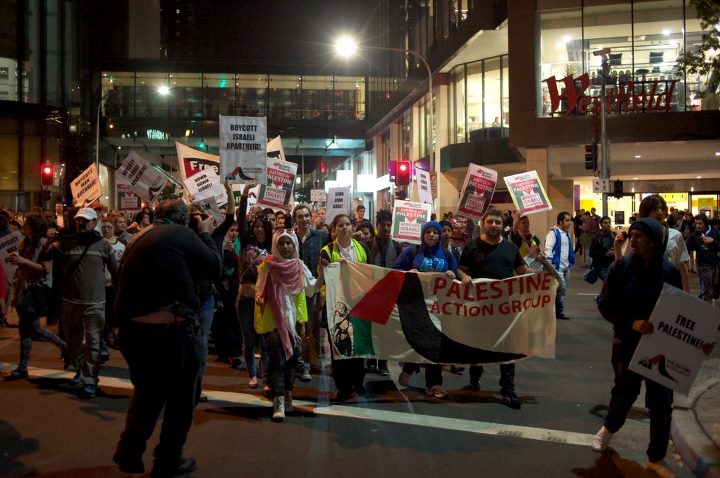
Stop the War on Gaza Protests in Australia

Stop the War on Gaza Sydney Protest

Speakers at the major Sydney protest against Israel’s war against the people of Gaza will include:

  • John Pilger, renowned author and documentary film maker
  • Antony Loewenstein, author of My Israel Question
  • Greens MP Sylvia Hale
  • Dr Ghassan Achi
  • Hamdi Alqudsi, Palestinian activist
  • Rihab Charida, Palestinian activist
Women in Black stop the war on Gaza Canberra

CANBERRA PROTEST FEBRUARY 3

Women in Black

We welcome you to stand with us, regularly or occasionally,
for an hour or even 10 minutes, any Friday, 1-2pm in Petrie Plaza.

We will also be at Parliament House (Melbourne Ave entry) for the start of Parliament on 3rd Feb 7.30-8.30am

RECENT PROTESTS

Hundreds of protesters picked Julia Gillard’s office at Werribee in Melbourne’s south-west on Friday.

One of the speakers at the rally, Mohamad Tabiaat, told AAP that Hamas militants were only fighting against Israel’s blockade that prevented essential goods getting to Gaza residents.

“Israel are being hit by small missiles that are a response to the blockade that is killing the people slowly as they are without medicine, water, electricity and other essentials to life,” he said.

“They should absolutely live in peace.

“We live in and are proud to be Australian, but Australia is supposed to be a fair country and are silent to what’s happening.

“We are here representing that silent voice.”

Foreign Minister Stephen Smith says the bombing of the UN headquarters in Gaza highlights the urgent need for an immediate ceasefire between Hamas and Israel.

Israel and Hamas are trying to negotiate a ceasefire in Egypt to the conflict, that has cost more than 1,000 mostly Palestinian lives.

The UN agency for Palestinian refugees suspended operations inside Gaza after its compound was hit by Israeli shells.

Mr Smith said any damage, whether deliberate or not, to a UN facility was both disturbing and regrettable.

“I think more generally it makes the point that whether it’s a UN building which is damaged, whether it is civilians who are injured or killed and whether those civilians are in Gaza or Israel, it underlines the point yet again that what we require here is an immediate ceasefire, an immediate implementation of this UN Security Council resolution…” he told reporters on Friday.

“We continue to urge all the parties to bring this resolution into practical effect.”

Israel Prime Minister Ehud Olmert had apologised for the damage to the UN compound, which was appropriate, Mr Smith said.

The Australian Greens say Prime Minister Kevin Rudd should call in the Israeli ambassador to express Australia’s horror at the bombing of the UN compound in Gaza.

Greens leader Bob Brown said the attack should cause the federal government to rethink its stance on the conflict.

“It is time the prime minister took decisive diplomatic action,” Senator Brown said in a statement.

“He should start by calling in the Israeli ambassador to express the Australian people’s horror at what is happening in Gaza.”

Senator Brown said Israeli human rights organisations, the UN and the Foreign Press Association had all expressed outrage at the ongoing conflict, which has resulted in more than 1,000 Palestinian deaths.

“Yet there has been no condemnation of the Israeli military’s actions by the Rudd government,” he said.

“Australia needs to be part of global diplomatic efforts to get the Israeli government to stop this sickening violence.”

Sphere: Related Content

  • Share/Bookmark