Google Reader or Homepage Subscribe Add to My Yahoo! Subscribe with Bloglines Subscribe in NewsGator Online Subscribe in FeedLounge Subscribe with Pluck RSS reader Kinja Digest MultiRSS Add to Technorati Favorites! Add to netvibes Include Add to FeedShow Add to FeedShow Add to Newshutch

Once a jolly swagman plugged into the internets,
Under the shade of a coolibah tree,
And he sang as he watched and waited as he torrented
“Don’t go deploying your filters on me”.

“Deploying your filters, deploying your filters
Don’t go deploying your filters on me”
And he sang as he watched and waited as he torrented,
“Don’t go deploying your filters on me”.

Down came the content speeding through the internets,
Up jumped the swagman and viewed it with glee,
And he sang as he shoved that content on his backup disk,
“You’ll be a-wasting your filters on me”.

“Wasting your filters, wasting your filters
Don’t go a-wasting your filters on me”
And he sang as he shoved that content on his backup disk,
“Don’t go a-wasting your filters on me”.

Up rode the Conroy, mounted on his ISP,
Down came the troopers, one, two, three,
“Where’s that jolly content you downloaded so illicitly?
You’ve been evading the filters from me.”

“Evading the filters, evading the filters
You’ve been evading the filters from me.”
“Where’s that jolly content you downloaded so illicitly?
You’ve been evading the filters from me.”

Up jumped the swagman and handed them his backup disk,
“You’ll never crack my encryption”, said he,
And his packets are tunneled and proxied through the internets,
“You’ll never get your bloody filters on me”.

“Your bloody filters, your bloody filters
You’ll never get your bloody filters on me”.
And his packets are tunneled and proxied through the internets,
“You’ll never get your bloody filters on me”.

from mudshark on Slashdot.

Sphere: Related Content

  • Share/Bookmark

The Minister for Digital Obstruction has decided to reduce his mooted 18 day EPIC FAIL blog to 16 days – get in now folks, you have till 3 pm on December 24 to vent your thoughts. And if this is the first you’ve heard about it, follow the links below and in previous posts here to bring yourself up to speed.

Conroy’s signature behaviours are scope-creep, secrecy and lies, in view of which trusting him, the present wowser government and their Hollow Men with upholding our individual human rights is patently unwise. Without revealing precisely who is participating in the ludicrous ISP filter trials yet or which filtering technology will be tested, Conroy’s latest scope creep is to include filtering of Bit Torrent and other P2P protocols in his trials, the commencement of which has now been delayed to mid January. Filtering unencrypted traffic is fraught with difficulties and expense, let alone considering the degrading effects on network performance and potential major dangers resultant from encrypted packet inspection at ISP level.

Pushed by news stories detailing a leaked IIA report commissioned by the Howard government which identified serious flaws in ISP filtering, Conroy has now published the full report himself. Contributor to the report, Bjorn Landfeldt makes further comment about blacklists on his blog.

“So, what is the big issue as I see it? A blacklist requires manual effort in order to determine what should be included. The Internet is a network of networked computers that carry information in many forms and realms, one of which is the World Wide Web. If we restrict ourselves to talk about only WWW, we have a global network with billions of pages worth of information. The information is made up of all different languages of the world and incredible diverse. Some information has a very high profile and some information has very limited visibility. Since a blacklist would rely on user reporting, it is questionable how efficient it would be to locate unwanted content in the first place. Second, every case would have to be tried to see if it breaches Australian law and falls within the categories specified for the filtering list. It will be a very difficult task to do this for content in the grey zone in all different languages. If the point is to stop child pornography, determining if a model is 19 or 25 in content from a different country with different jurisdiction is not an easy task and would be quite labour intensive. The next question is who is responsible for blocking of material that is legal if the wrong judgement is made?

The only way to identify such material quickly and significantly limit the risk of accidental access is to do some form of dynamic content filtering. However, the state of the art of such technologies is very limited in accuracy and if they are to be used there is a consequential performance impact on the response times of systems or at least an increased cost for the service provider. Current filters are rather good at detecting certain patterns of information such as a combination of many images and certain keywords usually means a porn site. However, there are at least two additional dimensions to consider. First, the current filters only look at such patterns, they do not try to analyse the actual content in any meaningful way. It is therefore difficult to distinguish between different types of content where there are similarities. For example, if a web site contains information about sex education or erotic content. Second, more and more content moves to other forms of multimedia and filtering and detecting the nature of content is much much harder in this case. For example, analysing a video and detecting that it has adult content is not a lightweight computational task. Separating sex education from porn is even harder. Third, if indeed there would be widespread filtering of content the providers would see a need to obfuscate content to fool filters. When we step into this realm it becomes very difficult for any filters to keep up.”

Confirming his continued commitment to filter trials, Conroy suggests that “International experience suggests that index-based filtering of a central blacklist is technically feasible.” But is it desirable or sensible?

In the face of the following, if he really cared about children, Conroy should repudiate his censorship plans immediately. The idiocy and counterproductivity of government blacklists in enabling, not preventing child abuse is perfectly illustrated with the publishing of the Danish and Thai blacklists on Wikileaks. Thai censorship was initially focused on child pron sites, and was expanded to include political censorship of sites which criticised the Thai royal family. The Fringe anticipates the leaking of the Australian blacklist is nigh.

Here’s some great Christmas links to remind us that Australians do care about their freedoms, even if government has forgotten it’s the servant of the people, not their ruler:

In Touch With The Obvious. Mostly says:

“In spite of the Senator’s reassurance, this is fundamentally an attack on free speech. Our laws are defined in such a way that whatever is not prohibited by law remains legal. (We legislate against certain behaviours, rather than regulate in favour of others.) Final responsibility for any action ultimately falls to the individual. By introducing an ISP-level filter, Sen Conroy has removed that freedom. In spite of your protests, Senator, you are censoring free speech by introducing this filter.”

The Fringe has read somewhat bemusedly the statement of Mike of Melb, who posted in hit and run fashion on this blog as The Observer. The statement in part reads:

“I have been interacting with several players involved in this whole process for over a year, on an ad-hoc and unpaid basis (advisory on technologies and market developments), however I recently agreed to be contracted with a vendor of ISP-filtering solutions.”

Meanwhile, Hoyden About Town has trouble making sense of this world. So do we!

Alex Byrne’s “The way of the wowser: censorship as a barrier to access to information” is a worthy reference on Australian wowserism:

“The wowser is a killjoy, one who wishes to spoil the pleasure of others especially in entertainment, alcohol and sex. It includes temperance advocates and homophobes. The way of the wowser is to seek to control the lives of others: in our domain, to bar access to information which the censor finds objectionable.”

And from the twitterverse:

@mpesce “”Politics is the art of looking for trouble, finding it everywhere, diagnosing it incorrectly and applying the wrong remedies.” — Groucho

Another example of gross governmental irresponsibility and inadequacy has come to light with the release of the Clarke report on the Haneef affair. Mick Keelty, the AFP, Howard and his Ministers will be protected despite the report’s findings of culpability. Cameron Reilly puts it not so mildly:

The report found that the AFP told the Howard Government that there was no evidence against Haneef – AND THEN CHANGED THEIR MIND. This is what they call “in good faith”?

I call it BULLSHIT.

So the Rudd Government is going to give the Howard ministers and the AFP a get out of jail free card. Does it have anything to do with how Rudd, when Opposition leader, didn’t have much to say about the Howard Government’s handling of the case? Or is it just favours for mates?

Heads should roll.

Over at Tech Wired Australia, Ben Grubb has a stellar piece about the victimisation by police of citizen journalist Nick Hac who last Friday was “threatened with arrest under the Australian Anti-Terrorism Act 2005 for videoing Police performing a search in public.” His phone was confiscated, searched and the video deleted despite him not consenting to search of his phone. Margaret Simon highlights this travesty on her blog at Crikey.


Sphere: Related Content

  • Share/Bookmark
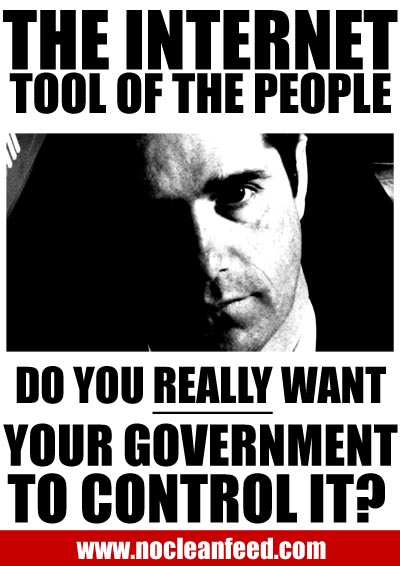
Say no to net censorship

Find December 13 Protest venues

  • Share/Bookmark

In an earlier comment on this blog, Observer wrote:

Sorry mate, but many of the blog entries clearly show that a majority of the public are actually mis-informed on these filtering initiatives. I have seldom seen so many mis-quotes and inaccurate statements passed on and reprinted en masse, then appears a day later reprinted in scores of blogs as fact.

Observer doesn’t actually bother to list any mis-quotes or inaccurate statements. Apparently merely asserting that there are some is enough to convince the uninterested reader that this is so.

And that is the danger with blogs. No evidence, no references, no accurate quotes, and often a mish-mash of what was actually said and was proposed.

Again, no evidence, no references, no accurate quotes. And, often, a mish-mash of what the arguments against the filter are. Touche, sir.

The scope of the filtering is an excellent example. Many people are outraged that there **would** be “”mandatory filtering”” of anything the gov deems inappropriate. What a load of bull, this has never been proposed.

There are many sources of outrage – I shall list a few:

  • that critics of the filter keep getting accused by a Minister of the Crown as being supporters of child pornography
  • that people keep asserting the filter will be equivalent in all respects to the operation of the National Classification Board
  • that the only material that will be targeted by the filter is material that would be illegal to possess offline (false: the ACMA blacklist can even include MA15+ material under some circumstances)

Observer continues:

Many bloggers are outraged that we now have censorship piled upon us. Fact? Australia has had censorship for over a 100 years for other mediums and media formats, this is now being applied to the Internet as a communications medium as well.

I think you will find that most opponents of the filter are outraged that the Government is attempting to censor a medium like the Internet as if it were a medium like TV, radio or books. The Internet is different – not because it licenses immoral behaviour – but because effective and unobtrusive censorship of it is almost impossible to achieve. Society needs to recognise that fact and use other mechanisms to deal with the problems it causes. We should maintain the classification system and we should retain controls over TV, radio, films and books, but we should also recognize that the Internet makes such controls somewhat pointless – a banned book can in principle be obtained in PDF form over a p2p network, even if it is Refused Classification here. It is fine for the Government to make pronouncements about standards, yet trying to enforce them with technically ineffective mechanisms is futile. Trying to enforce them with effective mechanisms would be totalitarian and definitely a bridge too far.

Many statements claiming the gov will be able to blacklist and control the content of the Internet. What a load of rubbish. The Censorship Board does this as with all other media formats, inc films, mags, books, TV etc. Give me a break.

Observer appears to be claiming that the mechanism being proposed to censor the Internet is in some way similar to the existing processes of the National Classification Board. It cannot be, for the following reasons:

  • a listing in the ACMA blacklist does not require review by the National Classification Board
  • the identity of content blocked by the ACMA blacklist is not published and is not subject to public review
  • the processes of the National Classification Board cannot be scaled up to deal with the volume of material that potentially falls within the scope of “prohibited online content”

Many claim the gov can secretly deny us access to content they do not approve of. Another load of old rubbish. You could only claim that if you have no idea how the Internet works… I can cross-check the contents of a blocked page within minutes, without accessing it, and these facilities are available to all Australians, and will be more available in the future. (Just get someone outside of Oz to check the page – hohumm how easy…)

On this point I agree – the Government will never be able to completely suppress information that it doesn’t want people to read. However, even the Great Firewall of China doesn’t work that way. Its main aim is to constantly remind the population that the Government is observing the media they consume. It is aimed at the middle 90% of the population, not the dissident 5%. They have different ways to deal with the dissident 5%.

I have argued that the Government’s plan only makes sense if it is viewed as a means of moderating the porn consumption habits of the middle 80% of the population. It has nothing to do with combatting actual perverts at all. It is all about moderating the (non-illegal) porn consumption habits of the middle 80%. Many may agree that this is a reasonable objective to aim for but setting the boundaries of acceptable porn usage is very definitely a political act in itself. Groups opposed to pornography will be fighting hard to get their least favourite fetishes included on the ACMA blacklist.

Myriad claims of probable false positives on the mandatory filters: Again a load of rubbish and again if the *experts* actually know anything about the Internet and content filtering, then they know that you cannot have false positives on a blacklist entry…. You can only have false positives on automated categorisation systems, that can incorrectly analyse the page. Complaints based entries into a blacklist, via review from the censorship board, are a manual and legally required process preceding blacklist entry for the madatory filtering. If you have a problem with a blocked page, complain to the Censorship Board, not the messengers…

You are assuming that the process which admits things to the blacklist is perfect and never makes a mistake. How could this be? the blacklist isn’t public and is not subject to review. It is simply false that an entry on the blacklist requires review by the National Classification Board. It does not, and if the blacklist is to be effective, it could not since the National Classification Board cannot scale its processes to the volume of material that is potentially blocked by the definition of “prohibited online content”.

Even if we restrict ourselves to the operation of the opt-out filter that will presumably use dynamic filtering (it has to if it is to be anyway effective), the concerns about overblocking and underblocking are very real. Then we have the unintended consequences such as the recent Wikipedia incident. And, remember, the Government’s plan is to subject everyone to opt-out filtering by default. The bulk of the population will have to deal with the consequences of inaccurate filtering unless they choose to opt-out; something they may well do if the filtering comes anywhere near its stated aims of making the Internet a “safe” place for children because such a filter will, almost by definition, be quite obtrusive in nature.

Another falacy? ISPs become the “Censors” and must decide on content. What drivel. Again, and for those not listening, the Censorship Board makes the DECISIONS on what is refused classification and thus illegal. No decisions by the ISP. The ISP is the gateway to the public and business sectors, and it is in their distribution networks that the technology needs to be applied. Nothing else. They carry no censorship responsibilities, but will be required to have the ability to implement the devices and software that can execute on the gov policy. Simple legal requirement, just like customs agents on the wharves and at airports…

Feel free to provide a quote where someone says that the ISPs will be making classification decisions in the case of the mandatory filter. The complaints I have read are that ISPs will be forced to carry the costs of running the censorwalls. The Government simply hasn’t specified how the opt-out filters are meant to work. There has been talk of dynamic filters run by unspecified commercial entities. Such filters don’t refer HTTP requests to the National Classification Board for real-time classification decisions. They involve applying rules to URLs and content. Will ACMA specify this rule-set too? Or will the decisions be delegated, by ISPs, to 3rd party filtering agencies? I would suggest that the latter is highly likely.

The ISP would be breaking the law if he interferes and makes censorship decisions. Anything clearer than that??

That’s a very big call to make when legislation hasn’t been drafted yet. Or perhaps you know something we don’t. Pray tell ..

FRallacy again folks? “We will have censorship like China” : More drivel. What an incredible insult to the Chinese who truly suffer under a repressive dictatorship and endure circumstances of deprivation, while we bask in sunshine, vote out governments we do not like, can openly protest, can insult the Minister every 5 minutes online in hundreds of blogs and can burn his effigy if we want.

In a very real sense, it will be like censorship in China. Perhaps not as extreme, but certainly it will be about making people think twice if they stray too far from the media consumption habits of the middle 80%. X-rated material is currently prohibited online content and presently can be listed on the ACMA blacklist. Until the Government states otherwise, such material is potentially subject to filtering by the mandatory filter. If an adult attempts to view such material and is blocked, they will wonder about whether they have done something illegal and they will moderate their future consumption of media material. It’s not totalitarian social control, but it is still control. And it is the only sort of control that the filter has any chance of delivering.

I would like my government to treat me as a responsible adult who can be trusted not to look at child pornography just because it is there. I haven’t had trainer wheels for 33 years, I don’t want them now.

What a mob of whingers… China does not have blogs like this, no open protests, no insulting Ministers, no Electronic Frontiers. But they have censorship way beyond anything proposed here. Get off your high horses folks and stick to reality, and stop insulting my associates in China who risk jail by just communicating across the Internet with the West.

I think too many of you have been watching too many Jason Bourne movies…

Perhaps we just don’t like the idea of handing the Government opaque mechanisms of social control on a silver platter. Perhaps you are firmly wedged in the middle of the middle 80% and never have reason to raise a voice in dissent. Perhaps your definition of the pornographic includes everything saucier than lingerie catalogues. That’s fine. This filter is made for you. In fact, you can buy it now. However, I am not sure why you insist that everyone else needs to be subjected to it.

BTW: Thanks for running the blog. I actually do appreciate being able to let off some of my own steam, and although it may look otherwise, it is not directed personally at any person… I want all the freedom I can on the Internet, but to be able to walk the streets in freedom the police must keep the crap off them as well…

And thank you for providing an opponent with whom to debate this issue. There are so few about. I am sure that if you start your own blog you will get lots of comments to help you “vent steam”.

Sphere: Related Content

  • Share/Bookmark
AWSOM Powered